
Vol. 1, Pt. 4: Separation of Powers in Immigration Governance
Part 4 of Volume 1, “Understanding Immigration Law,” of our Immigration Law Foundations series.
In Parts 1 through 3, we've explored immigration law's distinctive character: why it operates as a constitutional outlier, where federal authority comes from, and how the plenary power doctrine shields immigration decisions from meaningful judicial review. We've seen that immigration law doesn't follow normal constitutional rules. But understanding the doctrine alone doesn't explain how immigration governance actually works day to day.
The plenary power doctrine tells us that courts defer. It doesn't tell us who exercises power when courts step back. The vacuum left by minimal judicial oversight doesn't remain empty. Instead, it creates space for other branches’ authority, specifically Congressional and executive power, to expand in ways that would be checked more vigorously in other regulatory domains.
This brings us to the separation of powers: how Congress, the President, and the judiciary divide authority over immigration, why that division looks different from other areas of law, and why it matters profoundly for how immigration law operates in practice. Understanding this structural dimension is essential because immigration law's distinctive character emerges not just from doctrine but from institutional arrangements. The way power is distributed, the tools each branch wields, and the mechanisms through which policy changes happen all shape what immigration law can do and who it affects.
Three features make immigration separation of powers distinctive. First, Congress has written broad delegations that give the executive extraordinary discretion, more than in most regulatory areas. Second, courts defer not just to immigration substance but also to immigration procedure, accepting executive action that would face tougher scrutiny elsewhere. Third, and perhaps most importantly, immigration policy changes primarily through executive rulemaking and enforcement discretion rather than litigation, making the administrative process more significant than the judicial process for determining outcomes.
This blog examines how these structural features operate and why they persist. We'll see that immigration's separation of powers framework isn't just a technical matter of institutional competence. It reflects deep choices about democratic accountability, about which branch should make which kinds of decisions, and about whether immigration's special status serves legitimate purposes or simply enables policy swings that ordinary administrative law would constrain.
Congress: Broad Delegations and Minimal Standards
The constitutional structure starts with Congress. In our previous blog, we discussed how the Naturalization Clause gives Congress power to establish rules for citizenship and how the Commerce Clause, supplemented by foreign affairs authority, provides the constitutional hook for broader immigration regulation. In theory, Congress writes the laws that govern who can enter, stay, and become American.
In practice, Congress has chosen to delegate vast swaths of immigration authority to the executive branch.¹ This delegation isn't unusual in itself; modern governance requires administrative agencies to implement statutory frameworks. But immigration authority delegations stand out for their breadth, their vagueness, and their resistance to the intelligible principle doctrine that normally constrains how much authority Congress can transfer.²
The Nature of Immigration Authority Delegations
The Immigration and Nationality Act (“INA”) is Congress's primary statute governing U.S. immigration law. It's expansive, complex, and frequently amended, but its operational significance lies less in what it mandates than in what it authorizes. The INA establishes broad categories and legal frameworks, but it leaves enormous discretion to the executive branch to decide how those frameworks will be implemented through regulations, policy guidance, and adjudication.³
Consider the grounds of inadmissibility, the reasons someone can be barred from entering the United States. The INA lists various grounds: criminal convictions, national security concerns, public health risks, likelihood of becoming a public charge, fraud, and prior immigration violations. These categories sound specific, but they're actually quite open-ended.⁴
Take "public charge." The statute says someone is inadmissible if they're "likely at any time to become a public charge." But what makes someone likely to become a public charge? The statute doesn't say. It delegates to executive agencies to define the standard, identify relevant factors, and apply the test to individual cases.⁵ This has allowed different administrations to interpret "public charge" expansively or narrowly, creating wildly different policies from the same statutory text.
Or consider the grounds related to national security and terrorism. The statute authorizes exclusion for anyone the executive branch determines is engaged in terrorist activity, represents a danger to U.S. security, or whose entry would have "potentially serious adverse foreign policy consequences."⁶ These standards give the executive nearly unlimited discretion to decide who poses security threats. Courts reviewing these determinations face the plenary power doctrine's command to defer, creating layers of insulation from oversight.
Beyond inadmissibility grounds, the INA delegates discretion over enforcement priorities. The statute makes certain conduct unlawful, presence without authorization, overstaying a visa, working without authorization.⁷ But it doesn't mandate that every violation be prosecuted. Instead, it leaves enforcement decisions to executive discretion. This creates space for prosecutorial discretion programs, deferred action policies, and enforcement priorities that shape immigration law's real-world operation more than the statute's formal prohibitions.⁸
Why Immigration Delegations Are So Broad
Congress could write more specific rules. It could define "public charge" precisely, establish clear criteria for security determinations, or mandate enforcement of particular violations. Why doesn't it?
Several factors explain the immigration statute's broad delegations. First, immigration connects to foreign affairs, and Congress has long recognized that foreign policy requires executive flexibility.⁹ Relations with other nations shift. International crises emerge. What works diplomatically today might not work tomorrow. Congress can't anticipate every scenario, so it delegates to give the executive room to respond to changing circumstances.
Second, immigration politics are contentious. Writing specific rules requires difficult compromises. By delegating broadly, Congress can claim credit for addressing immigration ("we passed a law") while avoiding responsibility for unpopular specifics ("the agency made that decision").¹⁰ This political dynamic enables Congress to satisfy competing constituencies without resolving underlying disagreements.
Third, immigration administration requires flexibility because circumstances vary enormously across millions of individual cases. Someone seeking asylum from political persecution presents different equities than someone who overstayed a tourist visa. A person who entered unlawfully as a child differs from someone who repeatedly violated immigration law as an adult. Rigid statutory rules might produce unjust results. Delegating to agencies allows for case-by-case discretion that can accommodate equitable considerations.¹¹
Finally, the plenary power doctrine enables broad delegations by removing the constraint that normally limits them. In domestic regulatory areas, the nondelegation doctrine theoretically requires Congress to provide an "intelligible principle" to guide agency discretion.¹² In practice, this doctrine has become toothless; courts almost never strike down statutes for excessive delegation. But immigration delegations would strain even the minimal nondelegation scrutiny that exists elsewhere. Courts tolerate immigration's vague standards because the plenary power doctrine teaches that immigration is different, that normal rules don't apply with full force.
The Consequences of Delegation
The broad delegation shifts power from Congress to the executive and from the legislative process to the administrative process. When Congress writes specific rules, changing policy requires new legislation: hearings, committee markups, floor votes, bicameralism, and presentment. This process is slow, transparent, and demanding. It requires building coalitions and achieving supermajorities to overcome vetoes or filibusters.
When Congress delegates broadly, policy changes through rulemaking: notice-and-comment, agency explanations, and judicial review under arbitrary-and-capricious standards. This process is faster, more technical, and less visible. It requires agency expertise rather than legislative compromise.¹³ And it allows policy to swing dramatically with each new administration without Congressional action.
The public charge example illustrates this dynamic. Congress hasn't amended the public charge statute in decades, but its meaning has changed radically. The Obama administration interpreted it narrowly to focus primarily on cash benefits. The Trump administration expanded it to include noncash benefits like food stamps and Medicaid, making millions more people inadmissible. The Biden administration reverted to a narrower interpretation. Each change happened through rulemaking, not legislation.¹⁴ The statute's text remained constant while its operational meaning transformed.
This pattern repeats across immigration law. Enforcement priorities change with each administration. Asylum standards evolve through regulatory amendments. Visa processing becomes more or less stringent based on executive branch guidance. The statutory framework provides the vocabulary, but the executive branch writes the dictionary that gives words meaning.
Defenders of this system argue that it provides necessary flexibility. Immigration law must respond to changing circumstances, and the executive branch, not Congress, has the capacity to adjust quickly. Critics counter that executive dominance undermines democratic accountability and rule of law stability. When major policy changes happen through administrative action, they reflect presidential preferences rather than legislative consensus. This produces volatility as policies lurch from administration to administration, making it difficult for immigrants, employers, and agencies themselves to plan.¹⁵
The Executive Branch: Consolidating Power Through Discretion
If Congress's role is characterized by broad delegation, the executive's role is defined by expansive exercise of delegated authority. The executive branch doesn't just implement Congressional mandates; it shapes immigration law's substance through rulemaking, enforcement decisions, and adjudications that operate with remarkable autonomy.
Multiple Agencies, Fragmented Authority
Immigration authority is fragmented across multiple agencies within the executive branch, each with distinct functions but overlapping influence. The Department of Homeland Security (“DHS”) handles immigration enforcement and benefits adjudication through U.S. Citizenship and Immigration Services (“USCIS”), Immigration and Customs Enforcement (“ICE”), and Customs and Border Protection (“CBP”). The Department of Justice (“DOJ”) oversees immigration courts through the Executive Office for Immigration Review (“EOIR”). The State Department manages visa issuance through consular officers abroad.
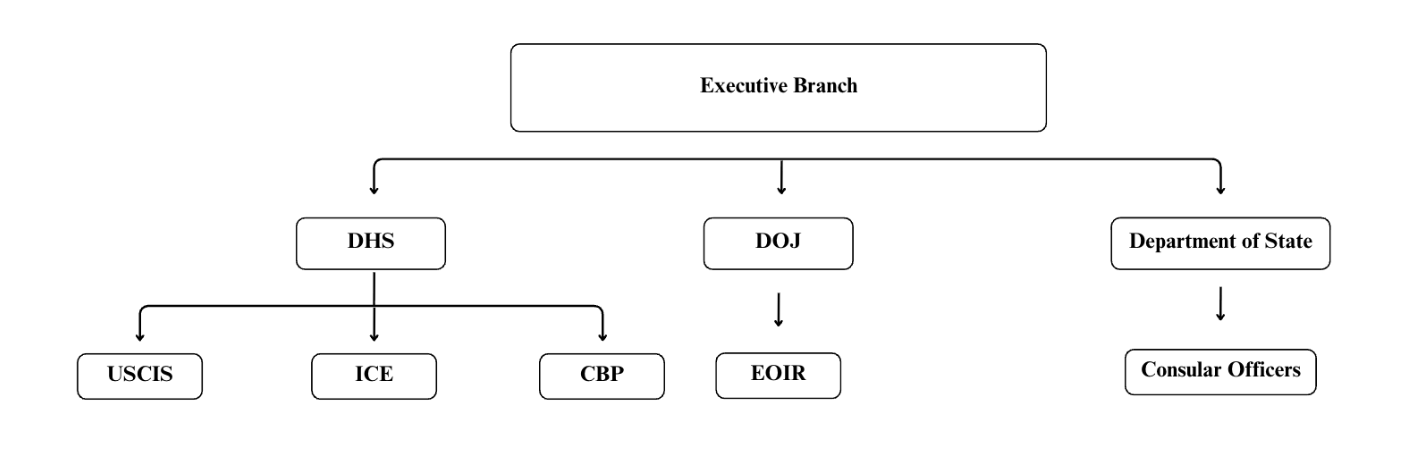
This fragmentation creates complexity but also concentrates power. All these agencies answer to the President. When the executive branch speaks with one voice across agencies, its immigration policy preferences become operational reality regardless of what Congress might prefer. The President can issue executive orders that direct multiple agencies simultaneously, creating coordinated policy changes that reshape immigration law without legislative action.
Enforcement Discretion as Policymaking
Perhaps the executive branch's most significant power is enforcement discretion: the choice of whom to prosecute, whom to prioritize, and whom to ignore. In theory, this discretion exists to allocate scarce resources. Immigration agencies cannot possibly enforce all immigration violations; there are millions of people present without authorization, and the government lacks resources to remove them all.¹⁶ Discretion allows focusing on priorities like serious criminals and national security threats.
In practice, enforcement discretion functions as substantive policymaking. When the Obama administration announced that it would not pursue the removal of people brought to the United States as children who met certain criteria, it effectively created a protection from deportation that Congress had declined to enact legislatively. The Deferred Action for Childhood Arrivals (“DACA”) program granted work authorization and temporary protection to hundreds of thousands of people based purely on executive discretion, not statutory amendment.¹⁷
Similarly, when the Trump administration announced that immigration enforcement would not distinguish between those with criminal records and those without, declining the Obama administration's priority system, it transformed who faced deportation risk. People who had lived in the United States for years with no criminal history became enforcement priorities despite having previously been considered low priority.¹⁸ The statutory basis for removal hadn't changed; the enforcement policy had.
Courts have generally accepted enforcement discretion as unreviewable. Administrative law normally provides that agency decisions not to enforce are committed to agency discretion and therefore not subject to judicial review.¹⁹ Immigration enforcement decisions receive even more deference because of the plenary power doctrine's overlay. The result is that the executive branch can effectively rewrite who faces deportation through enforcement priorities without statutory amendment or meaningful judicial oversight.
Rulemaking Power and Procedural Flexibility
Beyond enforcement discretion, the executive branch exercises power through rulemaking. Immigration agencies issue regulations that define statutory terms, establish procedures, and create substantive requirements. These regulations carry the force of law and bind private parties, immigration judges, and lower-level officials.
Normally, federal agencies must follow the Administrative Procedure Act's notice-and-comment process for substantive rules: publish proposed rules, accept public comments, respond to significant comments, and provide reasoned explanations for final rules.²⁰ Courts review these rules for compliance with statutory authority and for arbitrary and capricious decision-making.
Immigration agencies have broader latitude to evade these requirements. The APA exempts rules involving foreign affairs functions or military matters.²¹ Immigration agencies routinely invoke these exemptions to bypass notice-and-comment rulemaking. They issue guidance documents, policy memoranda, and interim final rules that take effect immediately without public input. When challenged, they argue that immigration inherently involves foreign affairs, triggering the exemption.
Courts sometimes push back, requiring notice-and-comment for major policy changes.²² But the foreign affairs exemption, combined with judicial deference to executive branch determinations about what affects foreign relations, gives immigration agencies more procedural flexibility than most agencies enjoy. This allows faster policy implementation but reduces transparency and public participation.
Adjudication Without Independence
Immigration adjudication presents another distinctive feature. Immigration judges, who decide removal cases and asylum claims, are not Article III judges with life tenure and salary protection. They're DOJ employees who serve at the discretion of the Attorney General. The Board of Immigration Appeals (“BIA”), which reviews immigration judge decisions, is also housed within the DOJ.
This institutional structure raises independence concerns. The Attorney General has the authority to overrule BIA decisions, establish binding precedents, and direct how immigration judges apply the law.²³ Recent Attorneys General have used this power aggressively to change substantive asylum standards²⁴, limit immigration judges' authority to terminate cases²⁵, and establish quotas and performance metrics that pressure judges toward faster denials²⁶.
The lack of independence means immigration adjudication responds to executive branch priorities in ways that federal district courts do not. When an administration wants tougher enforcement, the Attorney General can issue precedent decisions that narrow protections. When an administration wants different standards, it can change them through adjudicative precedent without going through notice-and-comment rulemaking. The adjudicative process, which in other contexts provides a neutral forum, becomes another mechanism for executive policymaking in immigration.
The Judiciary: Deference Compounded
We've seen how the plenary power doctrine creates minimal judicial review of substantive immigration decisions. But the separation of powers dimension adds additional layers of deference that compound the judiciary's limited role.
Deference to Executive Branch Interpretations
Administrative law generally requires courts to defer to agency interpretations of ambiguous statutes under Chevron deference.²⁷ If a statute is ambiguous and an agency's interpretation is reasonable, courts accept the interpretation even if they would have read the statute differently. This framework gives agencies substantial authority to shape statutory meaning through regulations and adjudications.
Immigration agencies receive Chevron deference, but they also benefit from additional deference specific to immigration. When an immigration regulation interprets the INA, courts apply Chevron. But when the interpretation also touches foreign affairs or national security, courts defer even more readily, finding ambiguity more easily and accepting agency reasoning more quickly than in other regulatory contexts.
The Supreme Court's recent curtailment of Chevron deference in Loper Bright may affect this framework going forward, but the plenary power doctrine provides a separate justification for deference that exists independent of Chevron.²⁸ Courts may require agencies to justify their interpretations more rigorously post-Loper Bright, but the baseline of deference in immigration cases remains higher than elsewhere because of immigration's perceived connection to sovereignty and foreign affairs.
Jurisdictional Restrictions
Beyond substantive deference, Congress has restricted federal courts' jurisdiction over immigration cases in ways that limit judicial oversight. The REAL ID Act of 2005 and subsequent legislation eliminated habeas corpus jurisdiction for many immigration claims, channeling review through the courts of appeals and imposing strict procedural requirements for raising issues.²⁹
These jurisdictional limits prevent courts from hearing certain claims altogether. For example, consular officers' decisions to deny visas are unreviewable except in extreme circumstances.³⁰ Expedited removal orders, which allow immigration officers to deport people at the border without hearings, receive minimal judicial review.³¹ Discretionary decisions, like whether to grant cancellation of removal, are explicitly exempted from review by statute.³²
The jurisdiction-stripping creates enforcement mechanisms that operate outside meaningful judicial oversight. Particularly for people detained at borders or in expedited proceedings, the theoretical availability of judicial review becomes practically meaningless. By the time a court could hear a challenge, the person has already been removed from the country, making relief impossible.
Limited Remedial Authority
Even when courts find that immigration agencies violated the law, their remedial authority is constrained. In ordinary administrative law, when an agency acts arbitrarily or exceeds its authority, courts can vacate the action and remand for further proceedings. The remedy is often nationwide, benefiting all similarly situated parties.
Immigration cases have seen increasing resistance to nationwide remedies. Recent Supreme Court decisions and Justice Department arguments have pushed for party-specific relief, arguing that courts should not enjoin immigration policies beyond the plaintiffs before them.³³ This limits judicial decisions' practical impact and allows agencies to continue implementing policies that courts have found unlawful against parties who haven't sued.
The remedy limitation means that even successful challenges may not change systemic practices. An immigrant who wins a court case gets relief, but others facing the same unlawful treatment must file separate lawsuits. This fragments litigation, makes systemic reform more difficult, and allows agencies to continue problematic practices while defending them case by case.
Why Courts Defer More in Immigration
The structural features we've examined, broad Congressional delegations, expansive executive discretion, and minimal judicial review, don't exist by accident. They reflect consistent judicial choices to treat immigration differently from other areas. But why do courts defer more in immigration? What makes immigration special enough to justify this differential treatment?
Sovereignty and Border Control
Courts consistently invoke sovereignty as a justification for immigration deference. The logic runs like this: controlling borders and defining membership are core sovereign functions. In the international system, nations have essentially unlimited authority to decide who can enter and who belongs. Courts should defer to political branch judgments about these fundamental sovereignty questions because the political branches, not courts, represent the people's will on matters of national self-definition.³⁴
This reasoning has intuitive appeal but raises difficult questions. Yes, nations control borders. But does that mean border control is immune from constitutional constraints?³⁵ The United States is a constitutional democracy where governmental power is limited and individual rights are protected. If immigration involves fundamental rights and significant liberty deprivations, shouldn't normal constitutional safeguards apply even if sovereignty is implicated?
The sovereignty argument also conflates international law with domestic constitutional law. Internationally, nations have broad discretion over immigration because international law imposes minimal constraints. But domestic constitutional law establishes different limits. The Constitution restricts government power even when that power concerns matters central to sovereignty. Courts review foreign affairs decisions, military actions, and national security measures despite their sovereign significance. Why should immigration receive unique immunity?
Foreign Affairs and Diplomatic Considerations
Immigration intersects deeply with foreign affairs. Admitting or excluding nationals of particular countries affects diplomatic relations. Refugee policies reflect foreign policy judgments. Immigration enforcement can create international incidents when other nations object to how their citizens are treated.
Courts have long recognized that foreign affairs require executive flexibility and judicial restraint. The President, not courts, conducts diplomacy, negotiates treaties, and manages international relations. When immigration decisions implicate foreign policy, courts defer to executive judgments because courts lack institutional competence to assess diplomatic consequences and because effective foreign policy requires the nation to speak with one voice.
This foreign affairs justification is stronger than the sovereignty argument, but still has limits. Not all immigration decisions genuinely implicate foreign policy. Whether someone who entered unlawfully thirty years ago should be deported doesn't typically raise diplomatic issues. Whether an immigrant qualifies for asylum based on past persecution rarely affects international relations. Courts could distinguish between immigration decisions that genuinely affect foreign affairs and those that are primarily domestic administrative matters, applying different deference standards accordingly.³⁶ They generally haven't made this distinction, treating all immigration as foreign-affairs-adjacent and deserving uniform deference.
National Security Concerns
Since September 11, 2001, national security has become central to immigration deference. Courts recognize that preventing terrorism and protecting national security are compelling governmental interests and that the executive branch has superior access to classified intelligence and expertise in threat assessment.
When immigration decisions rest on national security determinations, courts defer heavily. If the government asserts that someone is a terrorism risk or that a travel restriction serves security interests, courts generally accept that judgment without demanding detailed evidence. The executive branch invokes national security, and deference intensifies dramatically.³⁷
The problem is that national security has become an all-purpose justification for avoiding scrutiny. Immigration policies that have little genuine connection to terrorism or security threats are defended on national security grounds, and courts defer. The national security label becomes a shield against judicial review rather than a description of actual security needs. This transforms an understandable deference to executive expertise in genuine security matters into a blanket exemption from review whenever the government invokes the magic words.³⁸
Institutional Competence and Resource Allocation
Courts also justify deference based on institutional competence and resource constraints. Immigration administration involves millions of individual determinations annually. Immigration agencies develop expertise in assessing visa applications, asylum claims, and enforcement priorities.³⁹ Agencies understand resource constraints and operational realities in ways courts don't.
From this perspective, deference makes sense as a matter of institutional division of labor. Courts should not micromanage immigration administration or second-guess policy judgments that require balancing complex factors. The executive branch, not the judiciary, should decide how to allocate enforcement resources and respond to changing circumstances.
This institutional competence argument has force, but it proves too much. All administrative agencies have specialized expertise, face resource constraints, and make complex judgments.⁴⁰ We don't give the Environmental Protection Agency or the Securities and Exchange Commission the level of deference immigration agencies receive. Courts review agency decisions for reasoned decision-making and statutory compliance across regulatory domains without paralyzing agency function. Why immigration requires greater insulation from oversight isn't clear from institutional competence arguments alone.
Political Accountability
A final justification for deference emphasizes political accountability. Immigration policy involves value choices about the kind of nation we want to be, how open our borders should be, and whom we invite to join our community.⁴¹ These are political questions that should be answered through democratic processes, not judicial decree. The President is elected and accountable to voters. Congress represents the people directly. Courts are unelected and countermajoritarian.
If immigration is fundamentally political, judicial deference makes democratic sense. Courts shouldn't impose their policy preferences on immigration questions. They should defer to the political branches that answer to voters and can be held accountable at the ballot box for immigration decisions.⁴²
This accountability argument assumes that judicial review undermines democracy. But constitutional rights protect individuals against majorities. When rights are at stake, political accountability alone is insufficient. Courts enforce constitutional limits on political power even when those limits are unpopular.⁴³ The question isn't whether immigration involves political choices, it clearly does, but whether those choices are constrained by constitutional protections that courts have a responsibility to enforce.
Structural Reasons Rulemaking Matters More Than Litigation
The separation of powers framework we've explored has profound practical consequences. Perhaps the most important is that immigration policy changes primarily through administrative rulemaking and executive action rather than litigation. Understanding why rulemaking matters more than litigation reveals how immigration law actually evolves and why structural features shape outcomes more than judicial decisions.
Limited Litigation Success
In many areas of law, litigation drives policy change. Civil rights advances came through court decisions. Environmental protection expanded through litigation that forced agencies to regulate. Consumer protection law evolved as courts interpreted statutes broadly to serve remedial purposes.⁴⁴
Immigration litigation rarely achieves similar transformative success. Immigrants and advocates file thousands of lawsuits challenging removals, detention conditions, and agency policies. Most fail.⁴⁵ The plenary power doctrine, combined with jurisdictional restrictions and deference doctrines, creates formidable barriers to successful challenges. Even when litigation succeeds, remedies are often limited to individual parties, agencies can reverse course through new rulemaking, and precedent from one circuit doesn't bind others, creating splits that agencies can exploit.
The structural features we've discussed explain this pattern. Broad delegations give agencies latitude that courts defer to. Executive enforcement discretion is unreviewable. National security assertions trigger maximum deference. Jurisdictional limits prevent courts from hearing many claims. The result is that litigation provides only modest constraints on immigration authority.
The Primacy of Rulemaking
Because litigation achieves limited success, immigration policy changes primarily through rulemaking. When a new administration wants a different immigration policy, it doesn't wait for Congressional action or hope courts will reinterpret statutes favorably. It issues new regulations, guidance documents, and enforcement priorities that implement its preferred approach within the broad statutory framework Congress provided.
Rulemaking allows rapid, comprehensive policy shifts. An administration can publish a proposed rule, take comments, and finalize a new policy within months. The new rule applies nationwide immediately upon the effective date. It binds immigration judges, USCIS officers, ICE agents, and consular officials. A single rulemaking can affect millions of people more quickly and thoroughly than years of litigation could.
Consider asylum policy. The substantive standards for asylum are established by statute and treaty. But regulations define how asylum works procedurally: what forms applicants must file, what timelines apply, what evidence suffices, and whether applicants can work while cases are pending. By changing these procedural regulations, administrations can make asylum functionally more or less accessible without amending asylum's substantive definition.
The Trump administration issued regulations requiring asylum applicants to apply at the border, barring those who passed through other countries without seeking asylum there first.⁴⁶ The Biden administration rescinded those regulations and issued new ones. Each change happened through rulemaking, not legislation or litigation. The back-and-forth illustrates how the administrative process, not the judicial process, determines immigration policy's real-world operation.
Why Litigation Can't Counterbalance Rulemaking
In theory, litigation could check rulemaking excess. Courts review regulations for statutory authority and arbitrary-and-capricious decisionmaking. When agencies change policy, they must acknowledge the change and explain why the new approach is justified. This reasoned decision-making requirement should constrain agency discretion.
In practice, litigation provides only weak constraints on immigration rulemaking. The deference framework means courts accept agency justifications that would fail scrutiny elsewhere. Agencies can change policies by asserting that new circumstances require different approaches or that the prior administration misinterpreted statutory requirements. As long as the explanation appears reasonable and the agency considered relevant factors, courts typically uphold regulatory changes even when they represent dramatic policy reversals.
Timing also favors rulemaking over litigation. Rules take effect before challenges succeed. By the time a court invalidates a rule, it may have been in force for years, affecting countless people.⁴⁷ The agency can then issue a slightly modified rule that courts might uphold, or a new administration might issue different rules that supersede the litigation entirely. Litigation's slow pace allows agencies to implement policies and create facts on the ground before legal challenges resolve.
The Consequences of Administrative Primacy
The primacy of rulemaking over litigation has profound consequences for how immigration law operates. It means that presidential elections matter enormously. Each new administration can reshape immigration policy without Congressional action or successful litigation.⁴⁸ Policy becomes less stable and more responsive to electoral politics.
This volatility affects everyone in the immigration system. Immigrants don't know whether policies that protected them will survive the next election. Employers can't predict what immigration rules they'll operate under in coming years. Immigration lawyers must stay constantly updated on regulatory changes. Even immigration agencies struggle with whiplash as priorities and procedures reverse with each administration.
The administrative primacy also shifts where advocacy matters. If rulemaking drives policy more than litigation, advocates should focus on influencing rulemaking processes rather than filing lawsuits. This means participating in notice-and-comment, lobbying executive branch officials, and working within administrative processes. Litigation becomes a backstop or delay tactic rather than a primary tool for change.⁴⁹
Some see this as appropriate. Immigration policy should respond to the democratic will as expressed through elections. Administrative processes allow faster adaptation than litigation-driven change. Others view it as problematic. Policy instability undermines rule of law values. The lack of meaningful judicial oversight enables executive overreach. Reducing constraints on political branches invites abuse.
Reconciling Separation of Powers with Immigration Governance
The separation of powers framework in immigration governance creates a distinctive institutional arrangement: broad Congressional delegations, expansive executive discretion, minimal judicial oversight, and policy changes primarily through rulemaking rather than litigation. This arrangement differs from other regulatory areas where Congress writes more specific rules, courts apply stricter scrutiny, and litigation constrains agency action more effectively.
Is this arrangement justified? The traditional defenses invoke sovereignty, foreign affairs, national security, and political accountability. These justifications have force but aren't conclusive. Other areas touching sovereignty and security don't receive equivalent deference. Political accountability matters but shouldn't completely displace constitutional constraints. Foreign affairs considerations are real but don't justify avoiding all judicial oversight.
The current framework reflects choices, judicial choices to defer, Congressional choices to delegate broadly, and executive choices to exercise discretion expansively. These choices aren't inevitable. Courts could review immigration decisions more rigorously. Congress could write more specific statutory standards. The executive branch could self-impose constraints through binding regulations rather than flexible guidance. Different choices would produce different immigration governance.
What emerges from examining the separation of powers is that immigration law's distinctive character stems less from anything inherent in immigration itself and more from institutional decisions about how to allocate authority. The Constitution doesn't mandate minimal judicial review. Statutes don't require executive discretion to be unreviewable. These features emerged from doctrine, politics, and historical practice.
Understanding this helps us see possibilities for change. If immigration governance reflects choices rather than constitutional necessity, different choices remain possible. Reforms could strengthen judicial review, require more specific Congressional standards, or constrain executive discretion through procedural safeguards. Whether such reforms are desirable depends on contested questions about democracy, rights, and immigration's proper role in American law and society.
Conclusion and Looking Forward
This blog has explored how Congress, the executive branch, and courts divide authority over immigration and why that division looks different from other areas. We've seen that separation of powers in immigration governance tilts heavily toward executive authority, constrained weakly by Congressional specificity and minimally by judicial review. We've examined why courts defer more in immigration through sovereignty, foreign affairs, national security, and accountability justifications. And we've explored why rulemaking matters more than litigation structurally, not merely as a contingent fact but as a consequence of the institutional framework.
These structural features matter because they determine how immigration law operates in practice. The plenary power doctrine tells us courts defer. Separation of powers analysis tells us who exercises power when courts step back and how that power is wielded. Together, these doctrinal and structural features create immigration law's distinctive character: more responsive to political change, less constrained by legal process, more dependent on executive discretion, and less shaped by litigation than other regulatory domains.
As we continue this series, we'll move from constitutional foundations to statutory architecture. We've examined where immigration authority comes from and how it's divided among branches. Next, we'll explore the Immigration and Nationality Act itself: how it's organized, how definitions function as regulatory power, and why its cross-referencing complexity matters for understanding immigration law's actual operation. We'll see that the statutory structure isn't neutral or accidental but reflects choices about how to regulate immigration that have profound consequences for how the system works.
The foundation we've built, constitutional sources, plenary power doctrine, and separation of powers, provides the framework within which statutory immigration law operates. Understanding these foundational elements is essential before diving into the INA's complexity. Without grasping why immigration law is exceptional, the statute's architecture seems merely technical. With that foundation, we can see how the INA's structure embodies and reinforces immigration's distinctive legal character.
For now, remember this: immigration governance's separation of powers creates policy primarily through administrative processes rather than judicial decisions. When you want to understand how immigration law will change, don't look mainly to courts. Look to elections, regulatory initiatives, and enforcement priorities. That's where immigration law's real action occurs, in administrative agencies wielding broad discretion with minimal oversight, shaping millions of lives through rules and enforcement choices that shift with political winds.
This is Part 4 of our Immigration Law Foundations series. In Part 1, we explored why immigration law operates differently from other areas of law. In Part 2, we examined the constitutional sources of federal immigration power. In Part 4, we will explore separation of powers in immigration governance: how Congress, the executive, and the judiciary divide authority, and why courts defer more in immigration than in other regulatory domains. In Part 3, we traced the plenary power doctrine's origins and consequences. In Part 5, we will explore the Immigration and Nationality Act: how it's organized, how definitions function as regulatory power, and why cross-referencing complexity matters.
¹ Adam Cox & Cristina Rodríguez, The President and Immigration Law Redux, 125 Yale L.J. 104 (2015), especially Parts II–III, describe how the INA’s structure and complexity amount to a de facto delegation of vast screening and enforcement authority to the executive and how this is unusual in breadth compared to many other regulatory schemes.
² Scholarship on DACA and major questions, such as DACA’s Major Questions Exception(Hofstra Law Review), ties immigration delegations to the nondelegation and major questions doctrines and notes that immigration statutes frequently use open‑ended standards that would be problematic if courts applied a stricter nondelegation rule.
³ 8 U.S.C. § 1103 (INA § 103) charges DHS with the “administration and enforcement” of the INA and other immigration laws, which Cox & Rodríguez read as a broad enforcement and policymaking grant. Cox & Rodríguez emphasize that the INA operates less through precise ex ante rules than through large zones of ex post enforcement discretion, and that Congress’s layering of complex rules expands the domain in which the executive decides how the framework operates on the ground.
⁴ See INA § 212(a) and 8 U.S.C. § 1182(a) that set out grounds of inadmissibility.
⁵ See 8 USC 1182 (a)(4)(A) and (a)(4)(B) that renders inadmissistatute'sthe ble any noncitizen who, “in the opinion of” immigration officials, is “likely at any time to become a public charge,” and lists broad factors (age, health, family status, assets/resources/financial status, education/skills) without specifying weights.
⁶ INA § 212(a)(3)(C)(i) (8 U.S.C. § 1182(a)(3)) authorizes exclusion on national security and terrorism grounds, including persons the executive determines are engaged in terrorist activity, represent a danger to U.S. security, or whose entry may have “potentially serious adverse foreign policy consequences.” The Foreign Affairs Manual (9 FAM 302.14) interprets § 212(a)(3)(C) and explains that exclusion can be based on activities with “potentially serious adverse foreign policy consequences,” underscoring the breadth and discretion built into that standard.
⁷ 8 U.S.C. § 1103 again: the statute’s broad “administration and enforcement” language is the textual anchor for national enforcement policies and priorities. CRS Report, Executive Discretion as to Immigration: Legal Overview, details the scope of executive discretion in enforcing the INA, explaining that officials may decide “when, whom, how, and even whether” to enforce immigration laws and discusses deferred action and related mechanisms.
⁸ Another CRS Report, Prosecutorial Discretion in Immigration Enforcement: Legal Issues, provides an extended account of prosecutorial discretion in immigration, including the legal basis for programs like deferred action, the limits imposed by “abdication” concerns, and the interaction with multiple, sometimes conflicting statutory mandates.
⁹ Cox, Adam B., “Not So Exceptional,” NYU School of Law discusses how the plenary power doctrine and immigration’s link to foreign affairs have enabled sweeping executive authority.
¹⁰ David Rubenstein, “Immigration Blame,” 86 Fordham L. Rev. 125 (2017), provides a systematic account of how actors in immigration, Congress, agencies, presidents, use blame avoidance and delegation.
¹¹ Shoba Sivaprasad Wadhia, “Beyond Deportation: The Role of Prosecutorial Discretion in Immigration Cases” (NYU Press 2015), explains case-by-case discretion in removal, humanitarian factors, and why statutes leave room for individualized equitable judgment.
¹² See J. W. Hampton, Jr. & Co. v. United States, 276 U.S. 394 (1928).
¹³ Rosenbaum, Carrie L., “Arbitrary Arbitrariness Review” (SSRN), explains how immigration policy changes increasingly occur through agency action and are then constrained/channeled by arbitrary‑and‑capricious review rather than new statutes.
¹⁴ See explainer on the public charge rule that summarizes how the first Trump administration used rulemaking to expand “public charge,” how courts and the Biden administration reversed it, and how later rulemaking (2022) largely restored the older, narrower standard (focused on cash benefits) from 1999 guidance.
¹⁵ See Wadhia‑related and ACS materials. They frame prosecutorial discretion and changing enforcement priorities as responses to limited resources and changing circumstances but also flag concerns about fairness, predictability, and rule‑of‑law values when so much turns on agency choices.
¹⁶ American Immigration Council, The President’s Discretion, Immigration Enforcement, and the Rule of Law, explains that limited resources make it impossible to remove all removable noncitizens, so prosecutorial discretion is inherent and necessary, and that the “gap between law on the books and law in action” is largely filled by executive enforcement choices.
¹⁷ NILC, The President’s Broad Legal Authority to Act on Immigration, argues that deferred action programs, including DACA, rest on long‑recognized executive authority under the INA and implementing regulations, not on new congressional enactments.
¹⁸ DHS, John Kelly Memorandum, ‘Enforcement of the Immigration Laws to Serve the National Interest’ (Feb. 20, 2017), rescinds the Obama‑era Priority Enforcement Program (“PEP”) guidance and describes a broad list of priorities that, in practice, covers nearly all removable noncitizens.
¹⁹ See Heckler v. Chaney, 470 U.S. 821 (1985). It holds that an agency’s decision not to take enforcement action is “presumed immune from judicial review” as “committed to agency discretion by law” under the APA.
²⁰ Congressional Research Service, “An Overview of Federal Regulations and the Rulemaking Process” (CRS In Focus IF10003). This explains APA notice‑and‑comment, the logical‑outgrowth and reasoned‑explanation requirements, and judicial review standards.
²¹ See 5 U.S.C. 553(a)(1) and 554(a)(4), as summarized and applied in analyses of the “military or foreign affairs functions” exclusion.
²² An article from Lawfare noting that courts are likely to reject efforts to shield all cross‑border actions from APA review, while recognizing some scope for foreign‑affairs deference.
²³ CRS “Executive Discretion as to Immigration: Legal Overview” and similar analyses explain that the executive’s discretionary authority includes not only enforcement but also interpretive and adjudicative tools, with limited judicial review in many areas.
²⁴ See Matter of A‑B‑, 27 I&N Dec. 316 (A.G. 2018) and 28 I&N Dec. 199 (A.G. 2021). These Attorney General decisions sharply restricted asylum eligibility for people fleeing private, gang, and domestic violence, then were later modified/overruled by a subsequent AG, illustrating how AG certification is used to set and reset substantive asylum standards without new legislation.
²⁵ See Matter of S‑O‑G‑ & F‑D‑B‑, 27 I&N Dec. 462 (A.G. 2018).The AG held that immigration judges “have no inherent authority to terminate or dismiss removal proceedings” beyond narrow regulatory circumstances, significantly curbing judges’ ability to terminate cases.
²⁶ In 2018 EOIR implemented case‑completion quotas and performance benchmarks (e.g., completing a set number of cases per year, timeliness measures) as part of performance reviews, widely criticized as pressuring judges toward faster decisions and undermining due process; this is documented in bar association reports on EOIR’s 2018 metrics policy.
²⁷ Chevron deference is a legal doctrine in U.S. administrative law that tells courts to defer to a federal agency’s reasonable interpretation of an ambiguous statute that the agency administers. It comes from the Supreme Court case Chevron U.S.A., Inc. v. Natural Resources Defense Council (1984).
²⁸ In Loper Bright Enterprises v. Raimondo (2024), the Court ruled Chevron was inconsistent with the APA. The Court held: (1) The APA requires courts to exercise independent judgment, and (2) Courts cannot defer automatically to agencies on legal questions. This restored judicial supremacy in statutory interpretation. Courts now use independent judgment, but agencies still matter. Courts may consider agency interpretations as persuasive, but not binding. This is closer to an older doctrine called Skidmore deference (1944), which gives weight proportional to the agency’s expertise and reasoning.
²⁹ REAL ID Act of 2005, Pub. L. No. 109‑13, div. B, 119 Stat. 302, especially sections codified at 8 U.S.C. § 1252(a)(2), (b)(9), (e), eliminated most district‑court habeas jurisdiction over removal orders, channeled review into petitions for review in the courts of appeals, and established strict timing and issue‑exhaustion rules.
³⁰ See Kleindienst v. Mandel, 408 U.S. 753 (1972), which is the canonical consular nonreviewability decision (upholding visa denial where the executive offers a “facially legitimate and bona fide reason”).
³¹ 8 U.S.C. § 1225(b)(1) authorizes expedited removal for certain noncitizens arriving at or near the border and sharply restricts judicial review, limiting it to narrow habeas questions about whether the person is subject to expedited removal and whether procedures were followed.
³² 8 U.S.C. § 1252(a)(2)(B)(i) bars review of discretionary decisions, including many forms of relief such as cancellation of removal, adjustment of status, and voluntary departure, except for certain constitutional claims or questions of law.
³³ Department of Homeland Security v. New York, 140 S. Ct. 599 (2020) (Gorsuch, J., concurring in the grant of stay) criticizes nationwide injunctions and argues that courts should limit relief to the parties before them; commonly cited in debates over the scope of remedies in immigration and other federal‑policy cases. United States v. Texas, 599 U.S. 670 (2023) involves challenges to DHS enforcement guidelines; several opinions discuss standing and remedial scope and indicate judicial unease with sweeping nationwide remedies in immigration enforcement.
³⁴ See Trump v. Hawaii, 585 U.S. (2018), holding “For more than a century, this Court has recognized that the admission and exclusion of foreign nationals is a fundamental sovereign attribute exercised by the Government’s political departments.”
³⁵ See Louis Henkin’s Foreign Affairs and the United States Constitution (1972). He claims how sovereignty does not eliminate constitutional limits.
³⁶ See INS v. Chadha, 462 U.S. 919 (1983), showing how immigration can be subject to normal separation-of-powers constraints. Also see Judulang v. Holder, 565 U.S. 42; 132 S. Ct. 476; 181 L. Ed. 2d 449, applying ordinary administrative law review to immigration agency decisions.
³⁷ See Department of the Navy v. Egan, 484 U.S. 518 (1988), a landmark United States Supreme Court decision defining limits on judicial and administrative review of federal security-clearance determinations.
³⁸ David Cole, in his Judging the Next Emergency, 101 Yale L.J. (1992), supports the warning against uncritical deference. He writes, As Eugene Rostow argued in assessing the Japanese internment cases shortly after they were decided, ‘It is hard to imagine what courts are for if not to protect people against unconstitutional arrest… It is essential to every democratic value in society that official action taken in the name of the war power be held to standards of responsibility.’"
³⁹ National Immigration Forum, “Explainer: Asylum Backlogs” (Jan. 22, 2025), details how asylum adjudication is complex, resource‑intensive, and highly technical, and describes large backlogs at USCIS and EOIR.
⁴⁰ Lenni B. Benson & Russell R. Wheeler, reports on EOIR and immigration courts(e.g., for the Administrative Conference of the United States), document chronic resource shortfalls and structural issues in immigration adjudication, which undercut the idea that institutional competence alone justifies stronger‑than‑normal deference.
⁴¹ Chevron’s Asylum: Judicial Deference in Refugee Cases (Houston Law Review, 2021), explains that one of the central justifications for deference to the Executive is political accountability, i.e., that statutory interpretation often requires policy choices better made by elected or politically accountable actors than by courts.
⁴² The Case for Chevron Deference to Immigration Adjudications emphasizes that, under the INA, the Attorney General, an executive official ultimately answerable to the President, is at the apex of immigration adjudication, so that key immigration decisions are linked to elected political leadership rather than unelected judges.
⁴³ Chevron’s Asylum connects the need for judicial review to concerns about arbitrary or unstable interpretations in politically charged asylum decisions, suggesting that deference must be constrained to protect legal principles and, implicitly, individual rights.
⁴⁴ Hiroshi Motomura, Immigration Outside the Law (Oxford Univ. Press 2014) surveys removal, detention, and related litigation and emphasizes that courts rarely restructure the system in ways comparable to civil rights or environmental law; most cases affect individuals, not broad policy.
⁴⁵ Studies of removal/asylum outcomes show relatively low success overall and strong dependence on representation, underscoring that the system is not an easy vehicle for systemic change. For example, one empirical study of federal appellate immigration cases found an overall immigrant win rate around 15–16 percent, with better but still limited success in a small subset of cases.
⁴⁶ Interim Final Rule, “Asylum Eligibility and Procedural Modifications,” 84 Fed. Reg. 33,829 (July 16, 2019) restricted asylum eligibility for individuals who transited through a third country without seeking protection there.
⁴⁸ Numerous immigration law articles describe how modern immigration policy is made predominantly through executive action (rulemaking, guidance, enforcement priorities) rather than statutes.
⁴⁸Work on litigation rulemaking (where agencies shape court procedure itself) underscores that agencies can structure litigation in ways that diminish ex post judicial checks and thus raise the importance of ex ante administrative engagement.